Blog
We have spaces for workshops and various seminars. Get in touch to figure out how we can make your next event awesome.
Thessaloniki: See and Do
The city in a nutshell
A little bit European, a little bit Mediterranean, and a little bit Balkan Thessaloniki has always been a hub of politics, history, religion, commerce, and transportation for the region.
The second-largest city in Greece and capital of the Macedonia Region it was first established in 316 B.C. by King Kassandros and named after his wife, Thessaloniki, half-sister of Alexander the Great. It was the second most important city of the Byzantine Empire, next to Constantinople (today Istanbul). After 1430 the ottomans conquered and occupied Thessaloniki for almost 400 years. During this period the city became the most important commercial and trade center of the area and was considered of great strategic importance due to the trade routes established.
In the 15th Century, Thessaloniki became a haven for Jews exiled from Spain. During the Nazi occupation, 95% of Thessaloniki Jews were sent to concentration camps, ending a period of four hundred years of Jewish influence both socially and economically.
In 1917 the city center was almost destroyed by a huge fire creating a homeless population of 70.000. The city was rebuilt in the 1920s and during the 50’s and the 60’s it experienced unprecedented construction growth that transformed the city center to its present form. Today, Thessaloniki is a lively modern city bustling with life and movement, one of the largest student centers in South-Eastern Europe, Monuments like the Early Christian and Byzantine sites are declared by UNESCO as World Heritage Monuments and included on the UNESCO World Heritage List.
The first impression of the city can be a bit gritty. But in just a few hours, one can see so much beauty making it easy for Thessaloniki to win hearts.
Walk along the waterfront
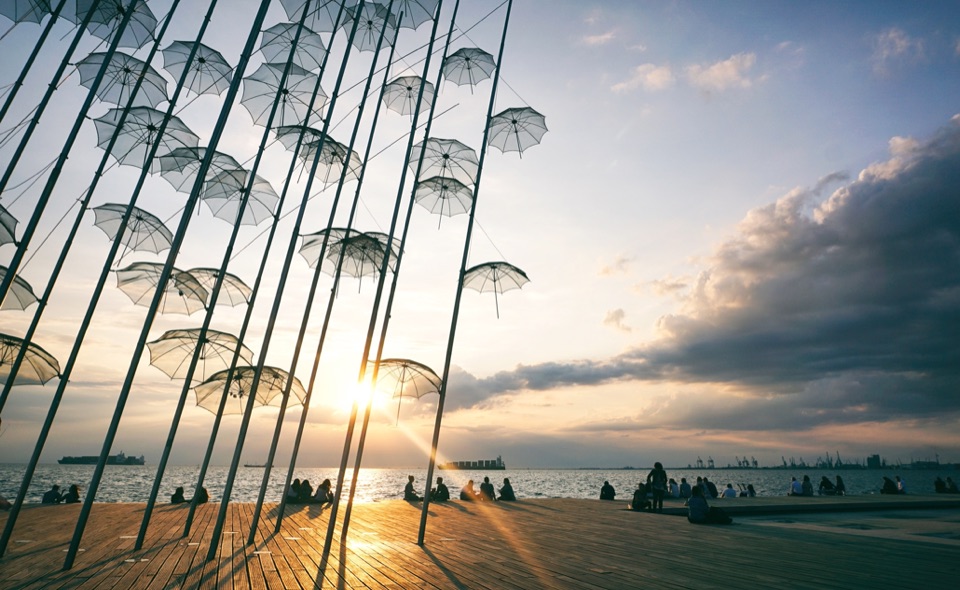
The first thing to do in the city is to walk along the waterfront. There you’ll find the city’s famous White Tower, although it’s much more interesting to walk along the newly refurbished boardwalk – the longest in Europe. The ancient tower, the tiny fishing boats, the seaside cafes, the graffiti-covered apartment buildings, the distant skyline of the industrial port – this is Thessaloniki in a nutshell. A walk along the water is the perfect way to recharge after a long and busy day.
Explore the city center
Ladadika is the word for shops selling oil and its products. During the Ottoman occupation, it was the central market and bazaar, also known as the Egyptian market. Nowadays, it is one of the most frequently visited places and perfect for a walk as it is only for pedestrians. There are a lot of options like espresso bars, coffee shops, tavernas, beer stores. The colors, sounds, and smells of Ladadika will give you a fair taste of Thessalonian entertainment.
Navarinou square is in the heart of Thessaloniki center. It is the most popular spot among students due to the modern cafes and the variety of nightlife options. It has recently become an attraction for tourists due to its alternative and local vibrant atmosphere. The square dates back to the Roman period of the city, the ruins of the palace of Galerius are located within it. Thessaloniki is like a huge open-air museum with Greek, Roman, and Byzantine antiquities that can be found in every step of the city’s historic center.
Aristotelous Square is the connection link between the architectural history of Thessaloniki and its modern style. It is the point where the sea meets the land in the most central point of the city and the starting point of a place full of open spaces to the public. A crucial place for Thessaloniki since it is the only open space in the center of the city. Its vast dimension is the point of hosting numerous events throughout the year, people’s meeting place, place of recreation, and promenade for the citizens and the visitors.
Athonos Square is one of the most vibrant and interesting areas of Thessaloniki. It is located just before Aristotelous Plaza and is considered one of the best places to eat. There are several taverns specialized in Greek traditional cuisine and recipes with several Balkan and Eastern influences. It’s a great example of Thessaloniki’s identity and history, being the crossroad of several different civilizations each one representing a different food culture and philosophy. The majority of the taverns and restaurants are beautifully decorated and some include live Greek traditional music.
Explore the Upper Town
Upper or Old Town is the only part of the city that survived the big fire of 1917. Walking through the stone-paved streets is like time stood still. You’ll immediately be stricken by its unique style, so different from that of the rest of it will travel you back to the city’s Byzantine past. The upper town can be reached on foot, if you don’t mind a bit of walking, or by bus. You will find numerous little taverns with the traditional cuisine of Minor Asia and Macedonia that reflect the area’s history and cultural identity. The amazing panoramic view of the city and sea will catch your breath.
Explore the markets
Thessaloniki is justifiably proud of its diverse food scene, with has strong Italian, Eastern, and Balkan influences. The adjacent Modiano (Thessaloniki’s largest sheltered market, currently closed for renovation) and Kapani markets offer great sightseeing, people watching, and eating experiences. There are shops and stalls for produce, meat, fish, cheese, spices, olives, herbs, teas, flowers, drinks, and more. There are also lots of little tavernas and bars where you can grab a quick bite.
Visit historical sites
Thessaloniki has the world’s largest number of UNESCO Byzantine monuments in the world and a large number of Roman ruins as well. Thessaloniki Walking Tours does fantastic English-speaking guided tours of both the markets and the city’s historical sites. You can combine both on a private tour. The most important sites include:
Heptapirgion, built by the Byzantines during the Paleologian Dynasty and located inside the Akropolis of Thessaloniki. It was used as a fortress for the city’s military guard and a safe retreat for the indigenous population in case of siege or raids.
Rotunda was built in 306 A.D. by the Romans, one of the oldest religious sites of the city. Original intentions were to use it as a mausoleum, although many archaeologists believe it was initially used as a Roman temple. The dimensions of the main structure are quite impressive.
Arch of Galerius, an excellent sample of the Roman monumental architecture of the 4th century A.D. The wonderfully crafted marble panels on each pillar have decorative and narrative characteristics. While the purpose was to emphasize the triumph of Rome, in the center of the scenes depicted we see the emperor Galerius and the imperial family. Galerius Arch and Rotunda were basic elements of the palatial complex.
Byzantine baths date to the late 12th/early 13th century and functioned continuously until 1940 when they shut down probably due to World War II and the German occupation of Greece. The Byzantine Bath of the Upper Town in Thessaloniki is one of the few and best-preserved of the Byzantine baths that have survived from the Byzantine period in Greece. It is located on Theotokopoulou Street in the Upper Old Town of Thessaloniki.
White Tower was built in the 15th century to replace an older 12th-century Byzantine fortification and it was later reconstructed by the Ottomans.
It was used as a fort enhancing the harbor’s defenses, as a garrison and a prison known as “Tower of Blood” (Kanli Kule) or “Red Tower”. It was renamed White tower (Torre Blanca) after it was whitewashed possibly in 1891.
Today the tower is open to the public and the visitors have a chance to enjoy a wonderful panoramic view from its highest level.
Roman Forum/Roman Market was a large open area surrounded by buildings of various functions. Some were elegant, impressive buildings, displaying the financial prosperity of the city, especially during the Hellenistic and Roman periods of its history and its growing strategic importance. It remained active during the 2nd, 3rd, and 4th centuries AD.
Bay Hamam, constructed by Murat II after the Ottoman invasion in 1430. The baths are considered unique for their impressive colorful designs and wall paintings with rich series of painted depictions of plants and other elements. Fully separated sections were available for men and women. The entrance to the men’s section was the main entrance looking towards the main Egnatia Street, while there was another one to the north of the building was designated for the women.
Important Museums
Thessaloniki has some terrific museums reflecting its long history and location at the crossroads of European and Ottoman culture. The most important are:
The Archaeological Museum of Thessaloniki, one of Greece’s largest museums, traces the civilization of Macedonia from pre-history to late antiquity and is crammed with dazzling ancient treasures.
The Museum of Byzantine Culture opened in the 1990s and is home to collections that cover the transformation of Roman religion and the early Christian Church to the 15th-century fall of Constantinople.
The Jewish Museum is set in a beautiful building dated back to 1906. The museum serves to acquaint the public with the city’s rich Jewish historic and cultural heritage.
There are also several wonderful contemporary museums and galleries to check out. The most important are:
Macedonian Museum of Contemporary Art: has over 2,000 works of photography, painting, sculpture, and engraving by Greek and international artists.
MOMus-Thessaloniki Museum of Photography: features regular Greek and internationally relevant exhibitions and events.
Thessaloniki Cinema Museum: is the only museum of its kind in Greece. It is also a hub for the city’s annual film festival, with many significant and rare exhibits.
The Olympic Museum of Thessaloniki: is officially recognized by the Olympic Committee, and has exhibits about the history of the games, the science of sports, and more.
Getting around
Thessaloniki makes a great base for exploring Northern Greece. Within 2 hours drive (number of km indicate the distance from the city), you can reach:
Meteora (225km), a rock formation hosting one of the largest and most precipitously built complexes of Eastern Orthodox monasteries, second in importance only to Mount Athos. The six monasteries are built on immense natural pillars and hill-like rounded boulders that dominate the local area.
Pozar thermal springs (110km) facilities with 48 individual baths, 6 indoor pools, the outdoor pool, hammams, jacuzzi, and spa, recommended for rheumatism, skin conditions, respiratory and circulatory problems.
Mount Athos (205km, more than 3 hours drive), the easternmost peninsula, home to a unique Christian Orthodox monastic state, inscribed on UNESCO’S World Heritage List. It is a millennium-old living proof of the Byzantine culture, surrounded by pristine nature. Please note that Mt. Athos accepts only male visitors.
Kerkini Lake (110km), an artificial reservoir in Central Macedonia and one of the top European bird-watching destinations. About 300 bird species have been observed here, among them, the Pelican and the Pygmy Cormorant, threatened with extinction. The area is also one of the most important cormorants’ and herons’ colonies of the Northern Balkan Peninsula.
Vergina (70km). In the ancient city, Aigai located here Alexander the Great was born, raised, and educated by the great philosopher Aristoteles. The archaeological treasures of the glorious Macedonian Kingdom of Alexander the Great and his father Phillip II, as detailed by Herodotus, invite you to a unique road trip to history.
Dion (89km). The religious center of the Ancient Macedonians dedicated to the worship of Olympian Zeus is situated at the foot of the famous Mount Olympus, the mythical home of the Gods. In Dion, Alexander the Great offered rich sacrifices to the Gods before leaving for his legendary expedition to Asia.
Volvi Lake (65km) with very interesting and rare ecosystems, hydro-habitats, hydrophilous plants, and trees. More than 200 bird species such as storks, egrets, flamingos, herons, etc, which are protected by the International Convention Ramsar, spend the winter in these regions. Also, several fish species can be found at Volvi lake.
Amphipolis (98km) has a Tumulus Tomb on the hill of Kasta inside a 500m long surrounding wall of marble and limestone. This great Tomb and the surrounding wall with its special base and unique design is likely the work of Architect Deinokratis, Alexander’s chosen Architect.
Cave of Alistrati (139km). From its antechamber of 8 m height start different high galleries fully decorated with impressive stalactites and stalagmites of different shapes and age. Inside the cave, countless floors are still unknown.
Cave waterfalls of Edessa (90km). Only four of the seven waterfalls can be visited. The largest is named Karanos, its waters fall from a height of 70m. Directly behind it, there is an impressive cave with a vaulted roof and remarkable interior decoration composed of stalactites and stalagmites. The waterfalls of Edessa are a unique natural phenomenon, one of the two existing worldwide due to the fact that they get shifted forwards forming primary caves, unlike other waterfalls that get shifted backward due to erosion.
Ski resorts: 3-5 pigadia (110km) in altitude 1430-2005m, one of the most modern ski centers in Greece with completed installations for tourist-athletic skiing and a system of artificial snowing, Ski center Elatochori (112km) located at an altitude of 1400m above the beautiful village of Elatochori in the Pieria Mountains, Ski center Seli (97km), located at an altitude of 1530m is suitable for beginner and intermediate skiers and snowboarders, Lailias Ski center (110km) located at an altitude of 1600m allows also nocturnal downhill ski runs due to proper night lightning of the sloaps.